In beauty clinics, assessing skin involves more than observing visible features such as skin tone and pores. Understanding the three-dimensional structure of the facial surface is also important. A 3D AI skin analyzer uses 3D scanning to capture facial data and generate a visual model, helping professionals examine wrinkles, localized depressions, and facial contours. Some devices also support measurements such as depth and area, making it easier to present analysis results to clients. Understanding the functions and limitations of 3D scanning helps clinics evaluate its practical value and apply it appropriately in client consultations and routine skin management.
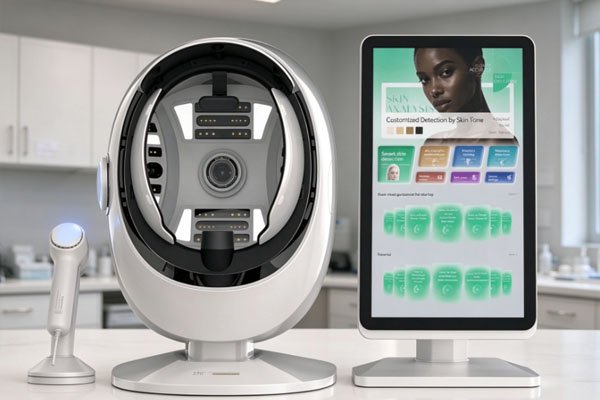
How Does 3D Scanning in a 3D AI Skin Analyzer Reveal Facial Features?
3D scanning converts facial surface information into a spatial model, providing a clearer view of the shape and structure of different facial areas.
Creating a 3D Facial Model
The device captures facial data through image acquisition or depth measurement, and its software uses the data to generate a 3D model.
- Displaying Facial Contours: Present the appearance of the forehead, nose, cheeks, jawline, and other areas in three dimensions.
- Observing Surface Variations: Help identify contour differences between facial regions.
- Supporting Client Communication: Use the model to explain facial features that interest clients.
The quality of the model depends on the device’s capture accuracy and reconstruction capabilities. It does not completely replace other methods of skin observation.
Examining Wrinkles and Localized Depressions
Compared with flat images, 3D models provide additional spatial information about surface structures, helping professionals understand localized features.
- Wrinkle Analysis: Examine wrinkle distribution, direction, and surface contours.
- Depression Observation: Identify localized depressions, such as pitted acne scars.
- Contour Comparison: Observe differences in elevation across facial areas.
These findings describe surface morphology and cannot directly determine skin elasticity or the condition of deeper tissues.
What Measurement and Comparison Information Can 3D Scanning Provide?
Some devices offer quantitative measurement functions that convert localized surface features into recordable data for future reference.
Measuring Local Surface Parameters
When supported by the software, the device can measure selected areas to describe surface characteristics more precisely.
- Depth Measurement: Record the surface depth of specific wrinkles or depressed areas.
- Area Calculation: Calculate the surface area of a selected region.
- Volume Analysis: Calculate volume parameters for depressed areas that meet the measurement requirements.
Available functions vary by device configuration. Results are also affected by scanning accuracy, region positioning, and the algorithms used.
Comparing Scan Results Over Time
Comparing data captured at different times helps professionals observe changes in facial surface morphology. They can compare 3D models to examine contour differences, review depth or area measurements when consistent methods are used, and store scan results in client records for future consultations. For more meaningful comparisons, facial posture, scanning angles, and device settings should remain as consistent as possible. Differences in measurements should not automatically be interpreted as proof of skincare treatment effectiveness.
How Can 3D Scanning Support Skin Management in Beauty Clinics?
3D scanning can be incorporated into result presentation, client consultations, and service recordkeeping, helping clinics explain visible facial features more clearly.
Making Client Consultations More Visual
3D models allow clients to view areas of interest directly, helping professionals discuss specific features more effectively.
- Visual Explanations: Display surface features such as wrinkles, depressions, and facial contours.
- Needs Assessment: Discuss daily skincare routines, including cleansing and moisturizing, based on client concerns.
- Result Interpretation: Explain key observations using the model and available measurement data.
3D scanning is a supplementary observation tool. It cannot replace medical diagnosis or independently prove the effectiveness of a skincare treatment.
Managing Client Analysis Records
Devices with data storage functions can save scan results for staff to review during subsequent services.
- Model Archiving: Save 3D models and their corresponding analysis reports.
- Historical Review: Retrieve previous records to understand areas of past concern.
- Service Continuity: Use existing records to support follow-up consultations and maintain continuity of service.
Clinics should establish appropriate access permissions and protect clients’ facial images and personal information.
What Should You Consider When Choosing a Skin Analyzer with 3D Scanning?
When purchasing a device, clinics should evaluate scanning performance, available measurement functions, and software management capabilities to ensure the equipment meets their service needs.
Verify Scanning Accuracy and Measurement Capabilities
Image acquisition quality affects the level of detail in 3D models and the usefulness of data comparisons.
- Scanning Consistency: Check whether repeated scans produce consistent models.
- Measurement Functions: Confirm which parameters the device supports, including depth, area, and volume.
- Level of Detail: Examine how wrinkles, depressions, and facial contours appear in the model to determine whether the device meets practical requirements.
Clarifying the available functions and measurement conditions before purchasing helps clinics understand the device’s actual capabilities.
Evaluate Software Usability and Data Management
Software affects how scan results are viewed, compared, and stored, as well as the efficiency of daily operations. Check whether scanning, model viewing, and report generation are straightforward. Confirm that the system can retrieve historical models and measurement data, and review the available operating training, equipment maintenance, and technical support arrangements.
3D scanning in a 3D AI skin analyzer creates facial surface models to help professionals examine wrinkles, depressions, and contours. Some devices also support depth, area, or volume measurements, providing reference information for tracking changes over time and conducting client consultations. When selecting equipment, clinics should assess scanning accuracy, measurement capabilities, and software functions according to their service needs while understanding the limitations of 3D data. Guangzhou Cosnext Technology Co.;Ltd can provide beauty clinics with equipment information and selection support to help them choose configurations suited to their service requirements.